A Novel Nuclear Role for Polysaccharides: Regulating the Chromatin Landscape
A new study reveals how modifying the nuclear inner membrane protein with polysaccharides affects nuclear regulation via an epigenetic mechanism.
Do Polysaccharides Play Roles Beyond the Plasma Membrane and Extracellular Space?
After synthesis by enzymes in the endoplasmic reticulum (ER) and Golgi apparatus, the transport of polysaccharides to the cell plasma membrane and extracellular space allows them to mediate a wide range of biological processes after being covalently attached to proteins, lipids, and RNAs. The nuclear membrane - a double-membrane structure continuous with the ER (Buchwalter et al.) - encloses the nucleus (Petrovic et al.); however, whether nuclear membrane proteins synthesized via the ER (Katta et al.) undergo modification by polysaccharides and how this may alter their function remains somewhat unclear. Of note, studies have revealed that the nuclear membrane interacts with silent heterochromatin regions marked by the repressive H3K9me2/3 histone modifications (Buchwalter et al.) as a mode of nuclear regulation; this finding begs the question, do polysaccharide-modified nuclear membrane proteins participate in this mode of epigenetic control?
Now, researchers led by Yang Mao (Sun Yat-sen University), Shisheng Sun (Northwest University, Xi’an), and Junjun Ding (Sun Yat-sen University) demonstrated the presence of polysaccharide-modified proteins in the inner nuclear membrane and the cell nucleus of diverse cell types. Their recent Nature Cell Biology article reports that N-glycosylation (with N-glycans being a class of polysaccharides covalently linked to the nitrogen of asparagine residues) of inner nuclear membrane proteins helps to maintain genome stability through an epigenetic mechanism involving H3K9me3 and the histone H3K9 methyltransferase SETDB1 (Tang, Dai, Qing, and Zhang et al.).
Paired-Tag technology from Epigenome Technologies generates joint epigenetic and transcriptomic profiles at single-cell resolution and detects histone modifications and RNA transcripts in nuclei with efficiency comparable to single-nucleus RNA-seq/ChIP-seq assays. Could an in-depth analysis of histone modifications beyond H3K9me2/3 and transcriptomic profiles of the same single cells via the integration of Paired-Tag reveal more regarding how the modification of nuclear proteins with polysaccharides can modulate the chromatin environment and, as such, regulate nuclear/cell function?
Polysaccharide Modification of Nuclear Inner Membrane Proteins Regulates the Chromatin Landscape of Cells
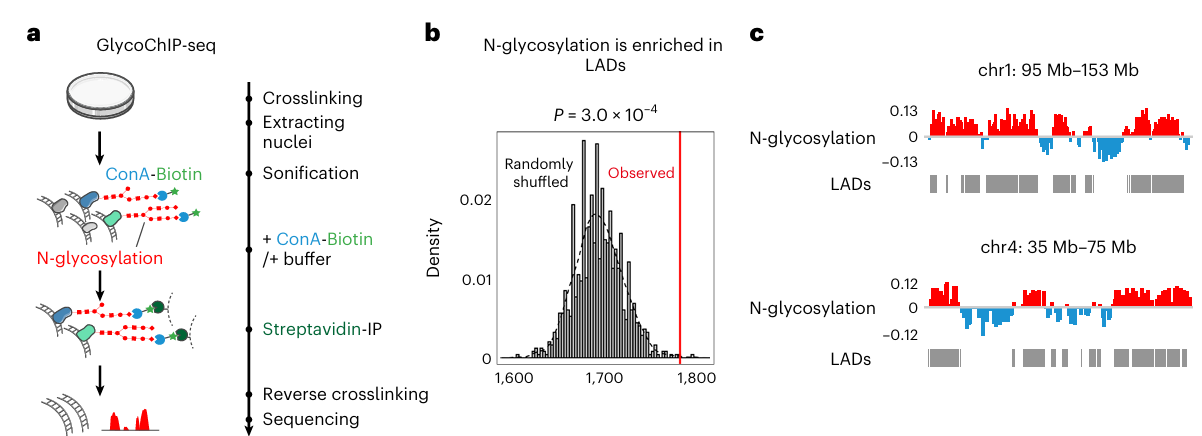
The authors of this new study revealed the modification of inner nuclear membrane proteins by N-glycan-type polysaccharides (mainly high-mannose N-glycans) and the presence of this modification across cell types with different species origins and developmental potentials (mouse totipotent-like stem cells, mouse/human embryonic stem cells, mouse pre-induced pluripotent stem cells, and mouse embryonic fibroblasts) through the application of site-specific glycoproteomic analysis. Furthermore, they validated these results by immunofluorescence, immuno-electron microscopy, and genome-wide chromatin immunoprecipitation followed by sequencing (GlycoChIP-seq); this latter approach employs biotinylated-concanavalin A to recognize N-glycosylation, streptavidin-based enrichment of the associated chromatin, and then next-generation sequencing to identify N-glycosylation-bound genomic regions.
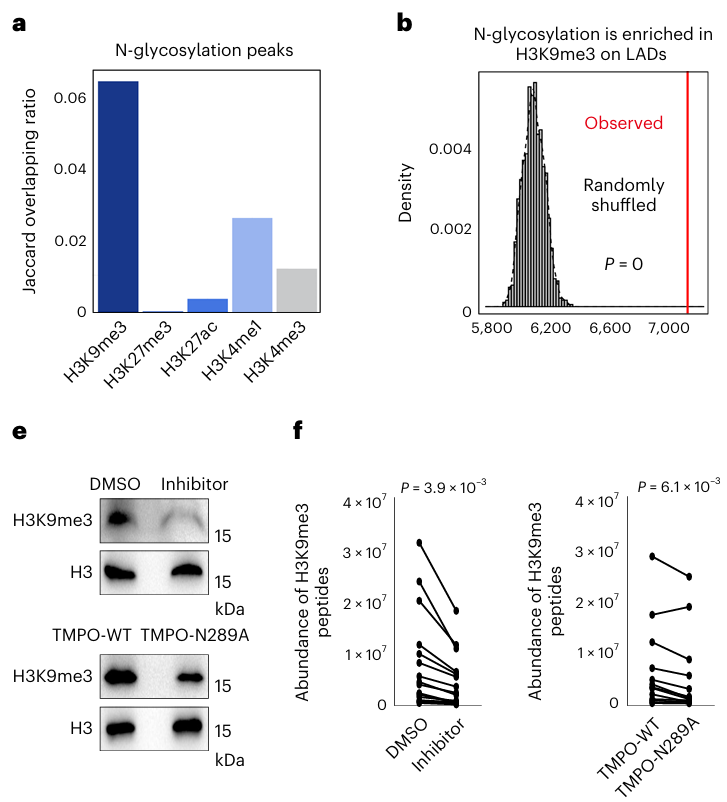
The authors also employed serial ChIP assays to reveal that the inner nuclear membrane protein TMPO (also known as Lamina-associated polypeptide 2/Lap2β) - which interacts with perinuclear chromatin and the nuclear lamina and contains an N-glycosylation site within its nucleoplasmic domain (Somech et al., Zullo et al., and Mirza et al.) - underwent N-glycosylation and bound to chromatin (predominantly in intergenic regions). They discovered that N-glycosylation displayed enrichment in chromatin regions marked by H3K9me2/3 and long interspersed nuclear element-1 (LINE-1) retrotransposons, which represent typically silent chromatin regions. As such, both the global inhibition of N-glycosylation using NGI-1, a small molecule inhibitor that blocks the transfer of N-glycans to peptides, and the N-glycosylation site mutagenesis of TMPO confirmed that N-glycosylation functioned to preserve H3K9me2/3-associated heterochromatin, suppress LINE-1 activity, and maintain genomic stability. Interestingly, they found that N-glycosylation regulated the interaction between the H3K9 methyltransferase SETDB1 and inner nuclear membrane proteins, thereby maintaining H3K9me3 levels.
Finally, the study highlighted that the canonical N-glycan biosynthetic machinery in the ER contributed to the N-glycosylation of inner nuclear membrane proteins and that atlastin (a membrane-bound GTPase essential for protein diffusion within the ER and regulator of inner nuclear membrane targeting; Pawar et al.) and nucleoporins (which regulate how proteins translocate through the nuclear pore complex) contributed to the targeting of N-glycosylation to proteins of the inner nuclear membrane. As abnormalities in inner nuclear membrane proteins have been implicated in disorders known as “nuclear envelopathies” (Burke & Stewart), the authors highlight the potential involvement of N-glycosylation deficiency-induced genomic instability in disease progression as an exciting future direction for their research.
Nuclear Proteins, Polysaccharides, and Epigenetic Mechanisms - Can Paired-Tag Provide Yet Further Insight?
Overall, these findings move polysaccharides beyond the cell membrane and extracellular matrix and now describe a previously unrecognized role for N-glycosylation of inner membrane proteins in nuclear regulation through an epigenetic pathway: the maintenance of H3K9me2/3-modified silent chromatin domains and genomic stability. The implementation of Paired-Tag technology from Epigenome Technologies, which generates joint epigenetic and transcriptomic profiles at single-cell resolution and detects histone modifications and RNA transcripts in individual nuclei with efficiency comparable to single-nucleus RNA-seq/ChIP-seq assays, has the potential to provide deeper insight into such research aims. Could the simultaneous single-cell analysis of histone modification and transcriptomic profiles help to define yet more links between polysaccharides and chromatin/nuclear regulation that would deepen our understanding of nuclear regulatory mechanisms?