Pronuclear Competition and Volume and Histone Modifications
Pronuclear Competition and Volume Regulate Histone Modification Patterning in Mouse Zygotes to Influence Developmental Potential: A recent study reveals links among pronuclear competition and volume, histone modification patterning, and the developmental potential of mouse zygotes.
Histone Modification Patterning: The Why of Pronuclear Separation in Mammalian Zygotes?
The fusion of a mammalian egg and sperm results in the formation of a zygote containing the maternal and paternal sets of chromosomes, each in a separate compartment known as a pronucleus. While the risks of this two-pronuclear (2PN) state to normal development/embryogenesis include potential chromosome segregation errors (Cavazza et al., Reichmann et al., and Schneider et al.), the potential benefits remain somewhat underexplored. Of note, studies have revealed the requirement for both parental genomes to establish chromatin-based regulatory mechanisms and developmental potential in zygotes (Barton et al., Ooga et al., and Surani et al.); however, the functional relevance of separating parental genomes into two pronuclei remained unclear. Interestingly, zygotes with both parental genomes in a single pronucleus (1PN) have been identified as a source of useful embryos for assisted reproduction, although studies have suggested they may be less likely to develop to term (Bradley et al. and Li et al.). Does the lack of pronuclear separation diminish the developmental potential of 1PN zygotes by some unknown mechanism?
Researchers from the laboratories of Hirohisa Kyogoku (Kobe University) and Tomoya S. Kitajima (RIKEN Center for Biosystems Dynamics Research) recently addressed this question and now describe a cytoplasm-mediated, competition-based mechanism between pronuclei that ensures developmental potential by regulating nuclear volume and epigenetic modifications. Overall, this new Nature study suggests that competition between parental pronuclei for a finite resource of the shared cytoplasm in a 2PN state limits pronuclear volume, which regulates the patterning of histone modifications such as H3K4me3 and H3K27me3 and, as such, developmental potential (Kyogoku et al.).
Paired-Tag technology from Epigenome Technologies generates joint epigenetic and transcriptomic profiles at single-cell resolution and detects histone modifications and RNA transcripts in nuclei with efficiency comparable to single-nucleus RNA-seq/ChIP-seq assays. Could the in-depth analysis of histone modifications and transcriptomic profiles of the same target cell via the integration of Paired-Tag reveal more regarding the intricate epigenetic links between pronuclear competition and volume and developmental potential?
Pronuclear Competition and Volume Regulate the Patterning of Histone Modifications
The authors first generated and analyzed zygotes containing both parental pronuclei but lacking separation (1PN biparental zygotes) and discovered dysregulated global levels of maternal H3K4me3, H3K27me3, and H3K27ac relative to 2PN zygotes by measuring immunofluorescence intensities of a range of modification-specific antibodies. Subsequent, more detailed analyses of H3K4me3 and H3K27me3 levels in 2PN and 1PN zygotes employed low-input carrier DNA-assisted chromatin immunoprecipitation followed by sequencing (CATCH-seq) (Matsuwaka et al. and Zhu et al.), revealing the inefficient de novo establishment of paternal H3K4me3 and H3K27me3 in 1PN biparental zygotes.
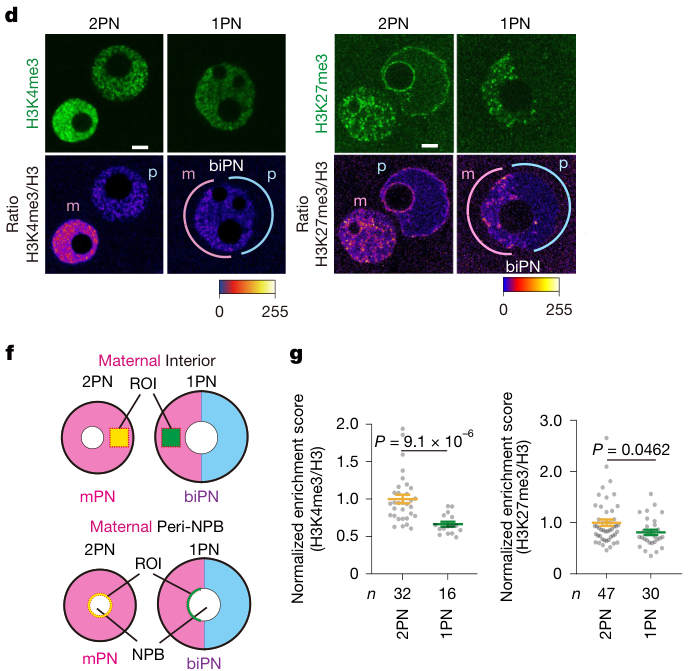
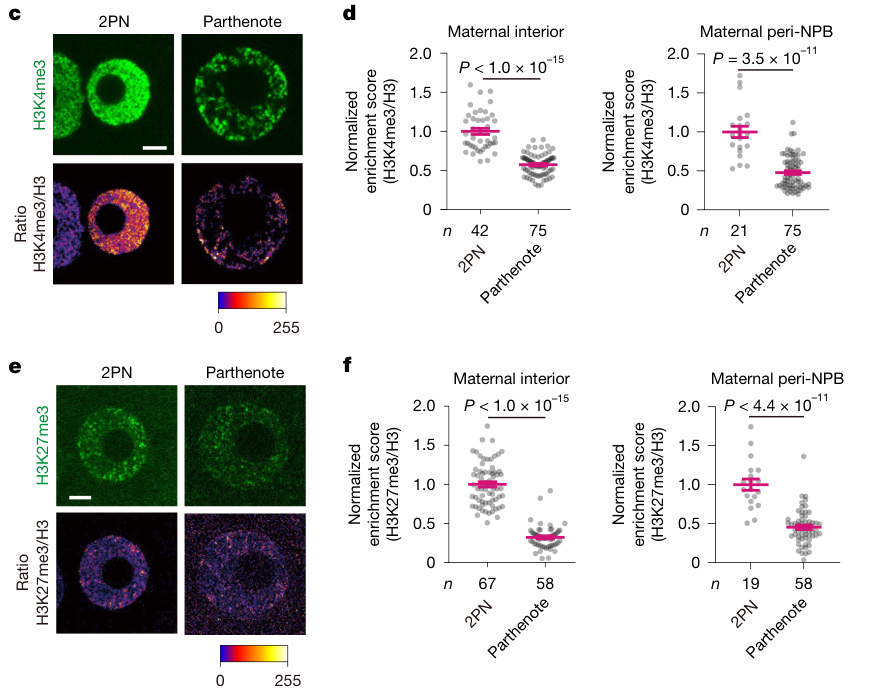
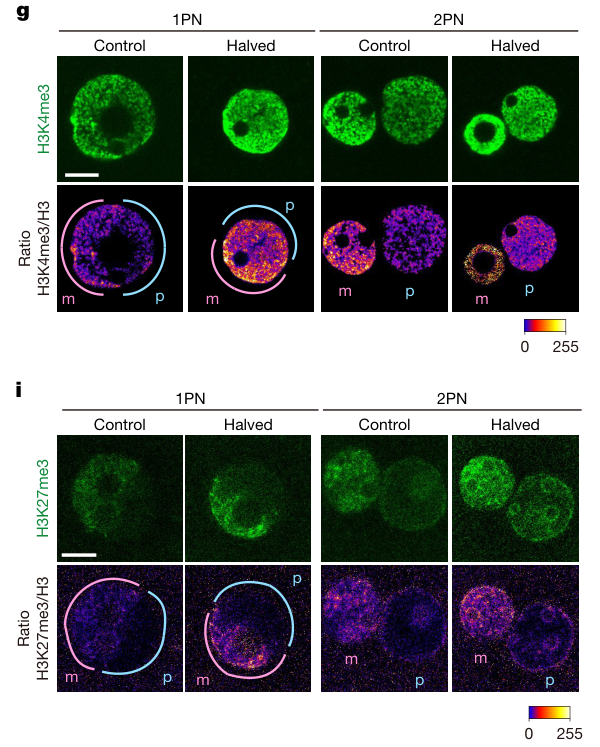
Interestingly, the study found that the intermixing of biparental nucleoplasms was responsible for the reduced levels of paternal H3K27me3 observed in 1PN biparental zygotes; however, the authors highlighted the likelihood that additional mechanisms linked to the 1PN state also affected maternal H3K4me3 and H3K27me3 levels and paternal H3K4me3 levels. When considering this mechanism, the team noted the existence of larger paternal pronuclei and smaller maternal pronuclei in mouse and human zygotes and a link between epigenetic information loss and pronuclear enlargement. Interestingly, experiments involving the fertilization of mouse oocytes with manipulated cytoplasm (Kyogoku & Kitajima) established that a finite cytoplasmic pool of components normally limits the volumes of the maternal and paternal pronuclei. Indeed, a combination of theoretical modeling and quantitative measurements suggested that cytoplasm-mediated pronuclear-to-pronuclear competition regulated pronuclear volume in zygotes. Overall, the team linked larger pronuclear volumes to reduced global levels of histone modifications such as maternal H3K4me3 and H3K27me3.
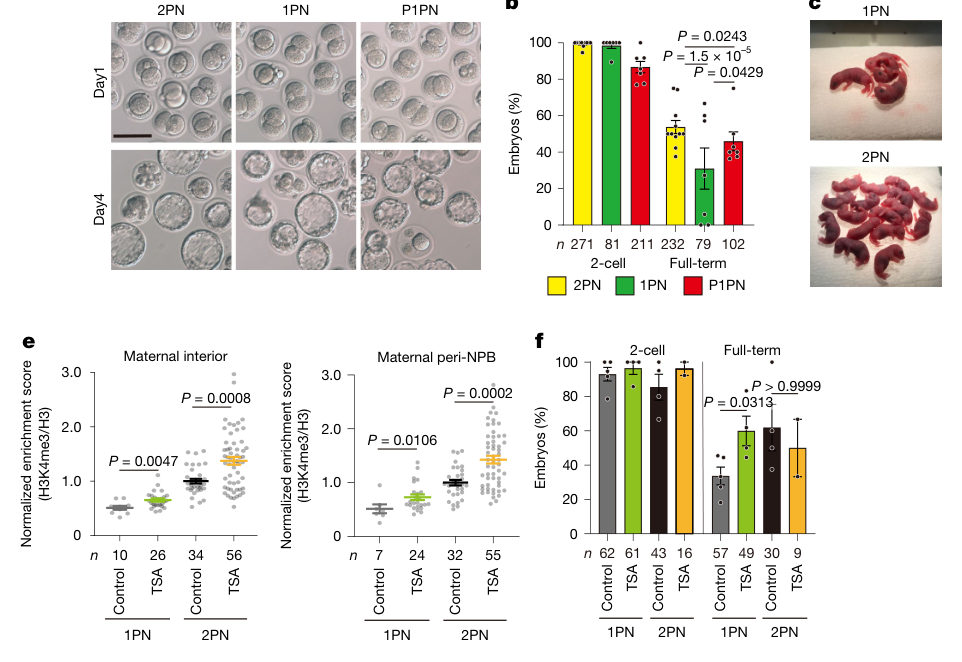
The subsequent analysis of developmental ability found that the 1PN biparental zygotes lacked full competence for embryonic development and displayed a tendency for loss after implantation, with a partial defect in zygotic gene activation - the critical event governing the transition from maternal to embryonic control of development - suggested as the reason. Excitingly, the authors revealed that a manipulation-based strategy that induced pronuclear-to-pronuclear competition, treatment with a histone deacetylase (which can increase H3K4me3 levels in zygotes), or RNA interference-mediated knockdown of the H3K4me3 demethylase KDM5b all rescued the developmental ability of 1PN biparental zygotes. Overall, these findings suggest that epigenetic defects underpin the developmental defects in 1PN biparental zygotes and highlight a potential drug-based strategy to improve their developmental potential.
Pronuclear Separation in Mammalian Zygotes: New Directions
Overall, this exciting epigenetic study revealed how the spatial separation of the parental genomes into distinct pronuclei controls proper embryonic development through a mechanism involving pronuclear competition, pronuclear volume, and histone modification patterning. The next steps in this research may involve exploring the factors underlying parental asymmetry in pronuclear volumes and the molecular mechanisms linking limited pronuclear volume to epigenetic regulation (which may involve the intranuclear dilution of factors regulating histone methylation status). The authors highlight proteins located at cytoplasmic lattices, which contain numerous chromatin modifiers and their regulators (Yan et al. and Jentoft et al.), as candidate factors subject to competition. Additionally, these findings support the importance of studying rescue strategies for 1PN biparental zygotes for future application in human assisted reproductive technology.
The implementation of Paired-Tag technology from Epigenome Technologies, which generates joint epigenetic and transcriptomic profiles at single-cell resolution and detects histone modifications and RNA transcripts in individual nuclei with efficiency comparable to single-nucleus RNA-seq/ChIP-seq assays, has the potential to provide deeper insight into such research aims. Could the simultaneous single-cell analysis of histone modification and transcriptomic profiles help to further explore how pronuclear competition and volume regulate the patterning of histone modifications in mouse zygotes to influence developmental potential?